
Michigan Inmate Population Search
Michigan's inmate population is tracked through the OTIS database, maintained by the Michigan Department of Corrections. You can search by name, MDOC number, or demographic details to find current and recently discharged offenders. State prisons, county jails, and city lockups each use different systems, so knowing where to look makes a real difference when searching Michigan inmate population records. This guide walks you through every tool available, from OTIS to VINELink to the Michigan State Police ICHAT, so you can find the records you need.
Michigan Inmate Population Overview
How to Search Michigan Inmate Population in OTIS
OTIS stands for Offender Tracking and Information System. It is the main public database for Michigan's inmate population and is run by the Michigan Department of Corrections. The system covers prisoners, parolees, and probationers who are currently under MDOC jurisdiction. It also includes people who left supervision within the last three years. You can reach it at mdocweb.state.mi.us/OTIS2/otis2.aspx. There is no fee to search, and no account is needed.
To start a search, go to the OTIS page and agree to the terms and conditions. From there, you can search by full or partial name, MDOC number, sex, race, age, status, or even physical descriptors like scars and tattoos. The results show a list of matching offenders. Click on an offender number to open a full profile. The profile includes physical details, aliases, the offense, sentence length, minimum and maximum release dates, county of conviction, and court file number. Mugshots appear when available. Some profiles show escape or absconder status and interstate compact transfer details.
The official OTIS information page explains the disclaimer language you'll see before searching. MDOC presents information without warranty regarding accuracy or completeness. If you believe a record is wrong, contact correctionsinfo@michigan.gov. For technical issues with the site itself, reach out to mdocwebmaster@michigan.gov.
The screenshot below shows the OTIS search interface as it appears when you access the database.
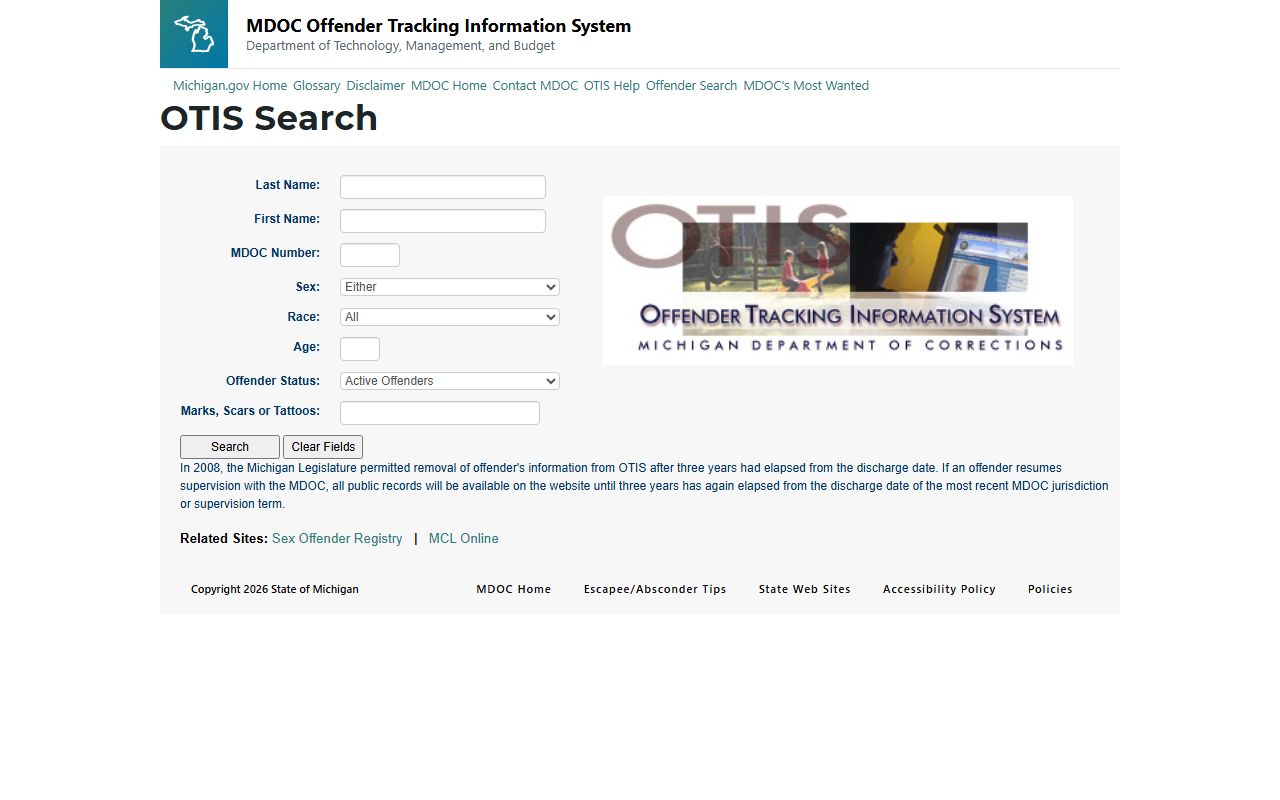
The OTIS search portal at mdocweb.state.mi.us is the fastest starting point for any Michigan inmate population search.
OTIS Limitations and the Three-Year Rule
OTIS does not hold every Michigan inmate record. It only tracks people currently under MDOC supervision, plus those discharged within the past three years. This is called the three-year rule. In 2008, the Michigan Legislature gave MDOC the authority to remove offender records from OTIS once three years had passed from the discharge date. If someone returns to MDOC supervision, their records become visible again until three years after their next discharge.
There are specific situations where a record gets removed even before the three-year mark. A conviction can be set aside or expunged by the sentencing court. It can also be expunged by operation of law. In those cases, MDOC removes the record from public view. Outside of expungement, time is the only factor. The three-year clock starts on the discharge date, not the release date.
OTIS also does not contain people who were arrested and convicted but not yet sentenced. County jail inmates don't appear here at all. City lockup detainees aren't in OTIS either. If you're looking for someone held in a local facility before trial, you'll need to contact the county sheriff or city police directly. The OTIS information page has the full disclaimer language if you want to read it before you search.
The OTIS information page shown here explains what the database includes and what it doesn't cover.
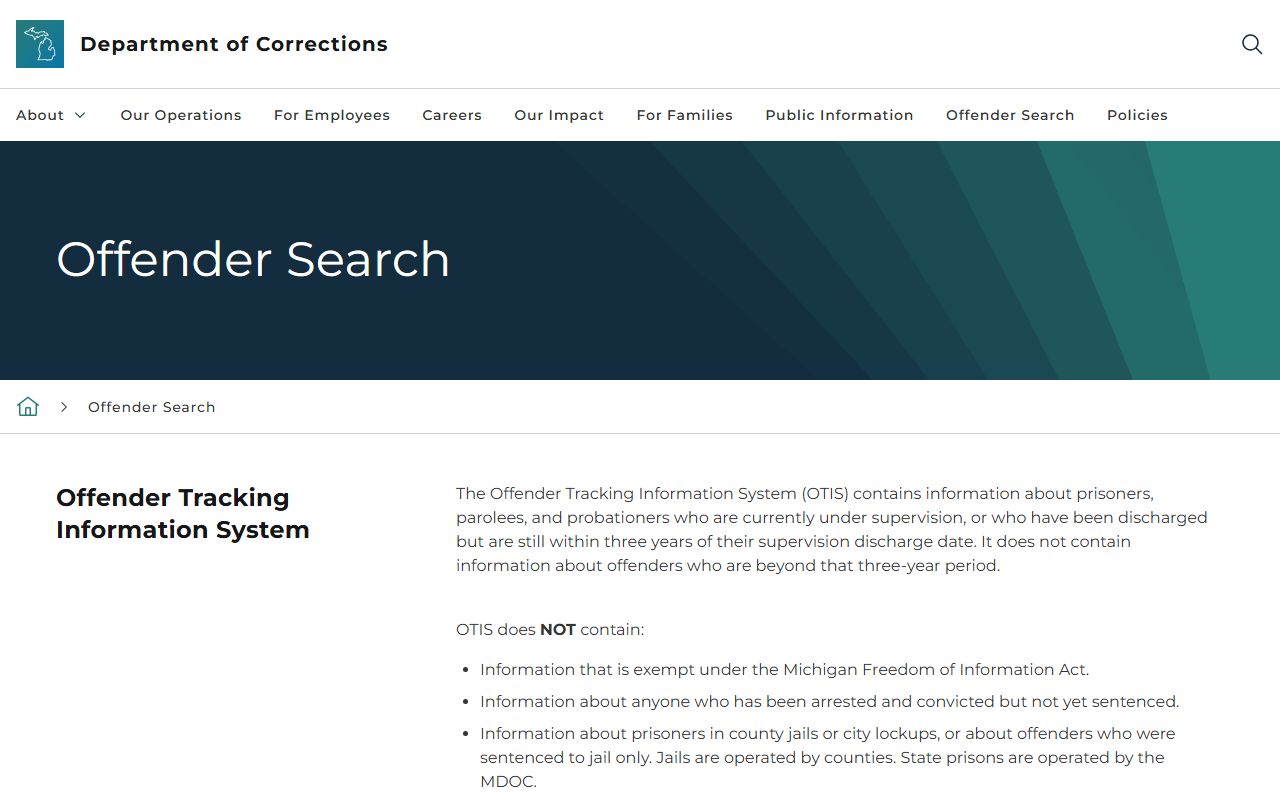
Review the disclaimer carefully before you search. It explains the scope and limits of the Michigan inmate population data available in OTIS.
Note: OTIS does not include county jail or city lockup inmates. For those, contact the county sheriff or local police department directly.
State Prisons, County Jails, and City Lockups
Michigan's inmate population is split across three types of facilities, and each one operates under different rules. State prisons hold people convicted of felonies with sentences longer than one year. The MDOC runs all 39 state prisons and is the agency responsible for custody and programming. OTIS is the search tool for state prison inmates and parolees.
County jails hold two groups: people awaiting trial who haven't posted bail, and people sentenced to less than one year. The county sheriff operates the jail. Each of the 83 Michigan counties runs its own jail system under MCL 800.31, which sets state standards for county jail inspection and oversight. County sheriffs maintain their own booking records. VINELink covers county jails, so you can get custody status updates through that system. For direct records, call or visit the county sheriff's office.
City lockups are the shortest-term holding facilities. Police departments use them to hold arrested people for up to 72 hours while processing takes place. These aren't long-term facilities. If someone isn't moved to a county jail within that window, they're either released or transferred. Records at city lockups are controlled by the local police department, not MDOC or the county sheriff. There is no single statewide search tool for city lockup populations.
Knowing which type of facility you're searching for saves a lot of time. State prisoner? Use OTIS. County jail? Try VINELink or call the sheriff. City lockup? Call the local police department.
The state prison facilities directory lists all 39 MDOC facilities by name and location. This page is a good starting point if you need to contact a specific prison directly.
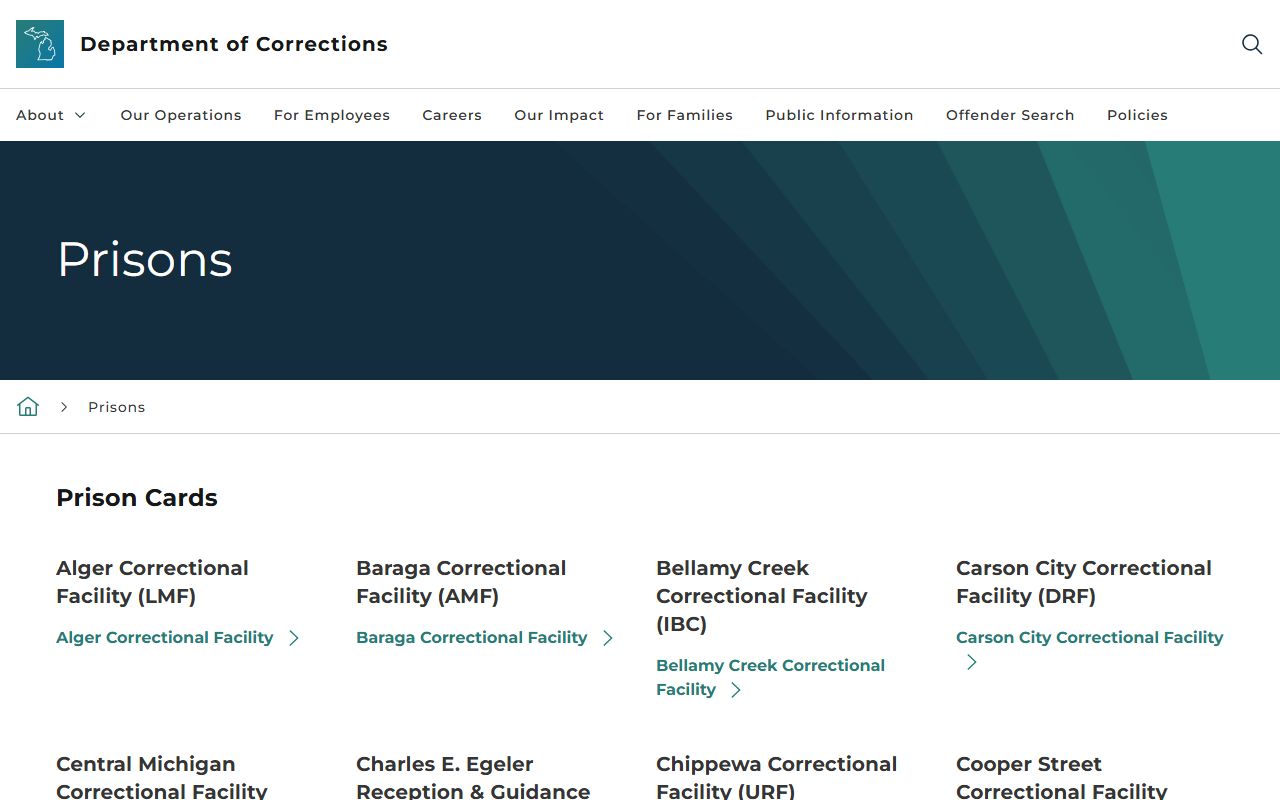
The MDOC facilities page at michigan.gov/corrections/Prisons is updated regularly and includes contact information for each facility.
VINELink Victim Notification for Michigan Inmates
VINELink is a free nationwide notification service. Crime survivors and family members can use it to get alerts when an inmate's custody status changes. In Michigan, VINELink covers both state prisons and county jails. You can sign up at vinelink.com or call 1-800-770-7657. Registration takes a few minutes and doesn't require any personal history or relationship to the offender.
Once you register, you'll get a PIN to manage your account. Notifications go out by phone, email, or TTY. You can set up alerts for more than one person, and multiple people can register for the same offender. The system is confidential. Offenders can't see who has registered to track them.
VINELink sends alerts when an inmate is released, transferred, escapes, returns to custody, or has a pending release date coming up. That advance notice is useful for people who need to plan for a release or make safety arrangements. MCL 400.701, the Crime Victim's Rights Act, provides the legal basis for Michigan's victim notification requirements.
The VINELink interface shown below is where Michigan residents can register to track inmate population status changes in real time.
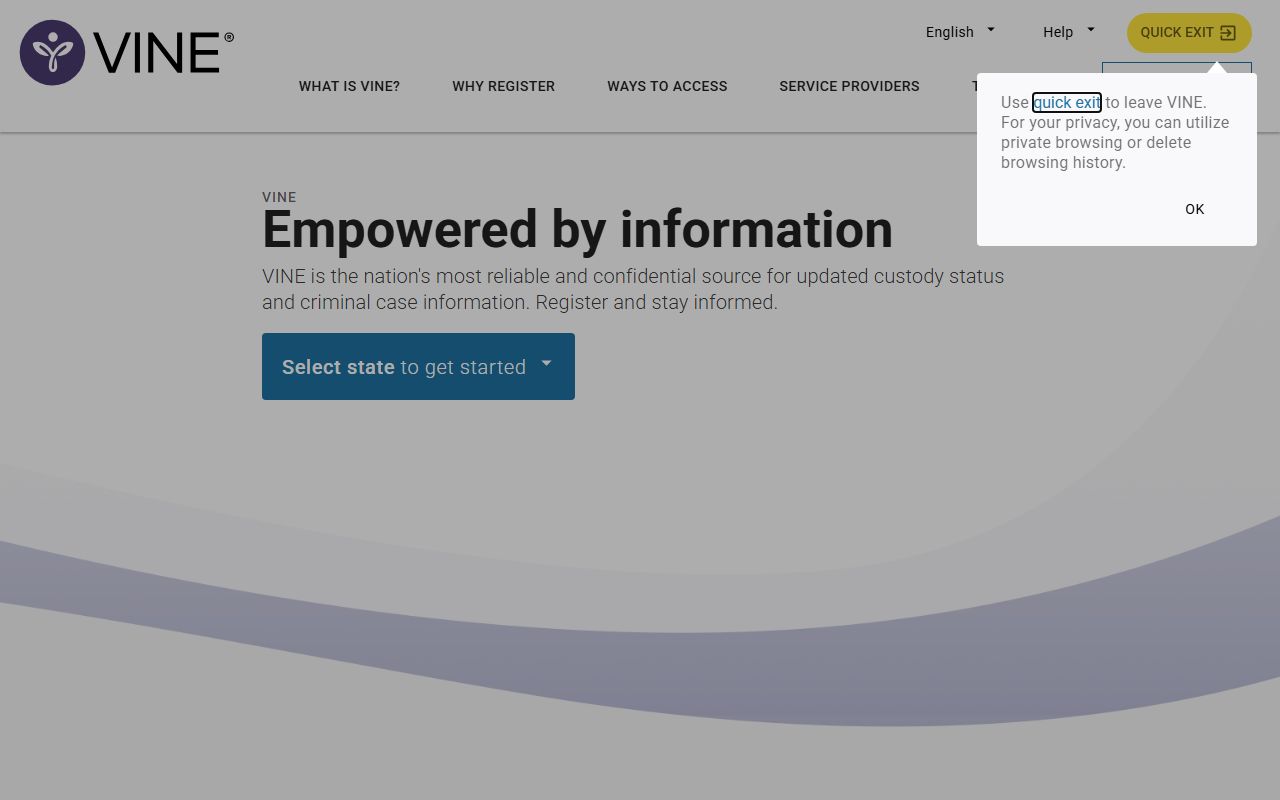
VINELink at vinelink.com is the most reliable way to get automatic updates about a specific Michigan inmate's custody status.
Michigan FOIA for Inmate Records
Michigan's Freedom of Information Act, codified at MCL 15.231, lets the public request records from state agencies including MDOC. A written request is required. It must describe the records with enough detail that the agency can find them. MDOC has five business days to respond. They can take an additional ten days if the request is complex.
Send FOIA requests to the MDOC FOIA Coordinator at the Litigation and Freedom of Information Division, P.O. Box 30003, Lansing, Michigan 48909. You can also check michigan.gov/corrections/about/foia for current procedures and any online submission options. Include the inmate's full name, MDOC number if known, and a clear list of what records you want. Being specific cuts down on back-and-forth delays.
Some records are off-limits under FOIA. Medical and psychiatric records are protected. Active investigation materials are exempt. Victim identifying information won't be released. Juvenile records are confidential under Court Rule 3.925. If your request is denied, MDOC must cite the specific statutory exemption. You have the right to appeal that denial to MDOC's FOIA Appellate Officer. The Michigan Attorney General's office at michigan.gov/ag also has FOIA resources if you need guidance on appeals.
One important note: prisoners themselves cannot file FOIA requests while they are incarcerated. That restriction applies only to the incarcerated person, not to family members or others acting on their behalf through normal channels.
Note: MDOC must respond to FOIA requests within 5 business days. An extension of up to 10 additional business days is allowed for complex or voluminous requests.
Michigan State Police ICHAT for Older Records
When someone has been off MDOC supervision for more than three years, OTIS won't show their record. That's where ICHAT comes in. The Internet Criminal History Access Tool is run by the Michigan State Police and is available to the public at michigan.gov/msp/services/ichat. Unlike OTIS, ICHAT is fee-based. It pulls from a broader criminal history database, not just MDOC records, and shows all Michigan convictions on file.
MCL 28.241 governs the criminal history record information system that ICHAT draws from. This statute gives MSP the authority to collect and maintain conviction records from courts across the state. ICHAT is most useful when you know someone had a Michigan conviction but their information no longer appears in OTIS. It's also the right tool when you want a fuller picture of someone's criminal history across multiple incidents and jurisdictions within Michigan.
The search process is straightforward. Go to the ICHAT page, pay the fee, and enter the person's name and date of birth. Results show conviction records on file with the state. It's a public records tool for anyone who needs to know about a person's Michigan conviction history.
Michigan Sex Offender Registry
The Michigan State Police maintains the state's sex offender registry at michigan.gov/msp/services/sex-offender-registry. This is a free, public database that requires no registration to access. You can search by name, by county or address, or by proximity to a specific location. The registry shows each offender's tier level, whether they are in compliance with registration requirements, and conviction details.
Michigan uses three tier levels. Tier I is the least serious, Tier III is the most serious. Tier levels affect how long an offender must register and how often they must verify their information with police. Tier III offenders must register for life. Some sex offenders also appear in OTIS if they are still under MDOC supervision. The registries are separate systems, so it's worth checking both if you're doing a thorough search.
The sex offender registry shown below is maintained by the Michigan State Police and is updated regularly when offenders report changes.
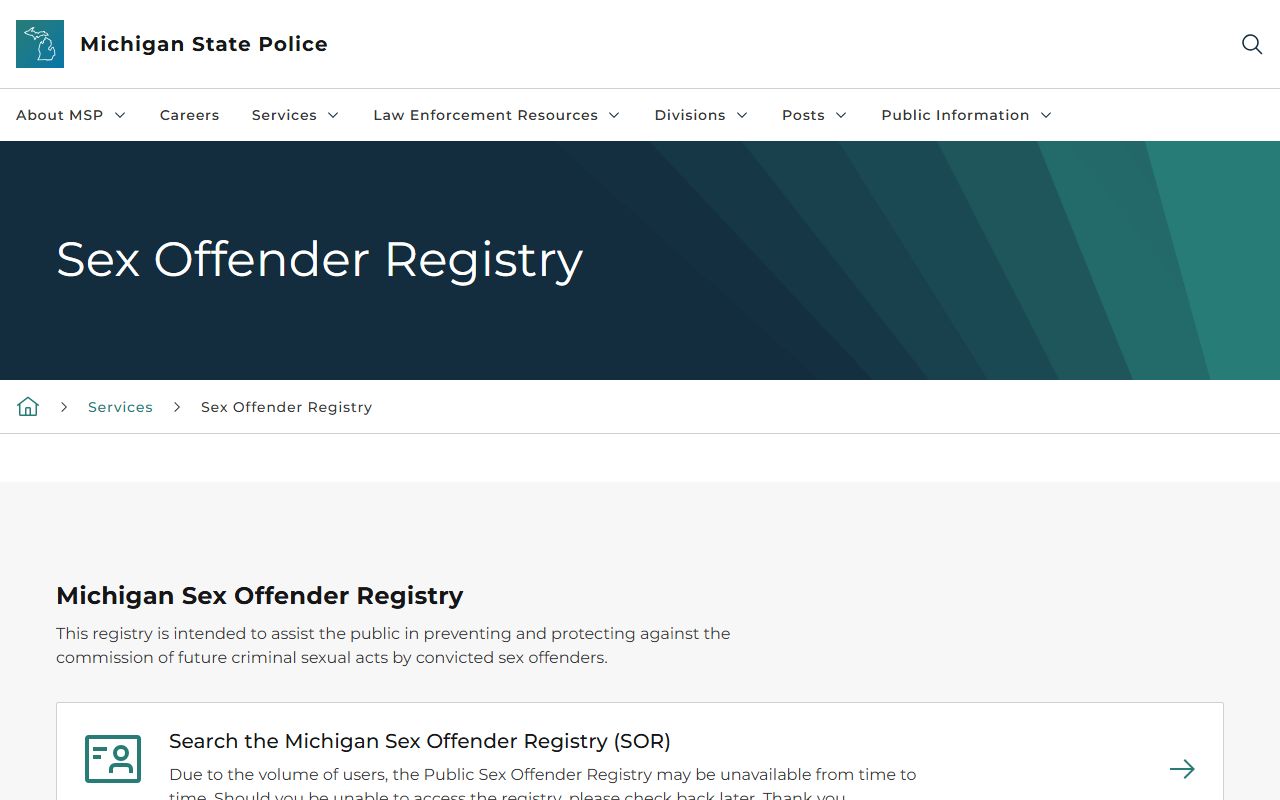
The registry at michigan.gov/msp/services/sex-offender-registry is a separate system from OTIS and should be searched independently when needed.
Michigan Court Records and MiCOURT
Court records are a useful supplement to OTIS when researching Michigan inmate population data. The Michigan Supreme Court runs the public case search portal at courts.michigan.gov/case-search/. No account is needed for basic searches. You can look up cases by party name, case number, or filing date. Results show charge information, hearing dates, case status, and dispositions.
Court records and OTIS records are different things. OTIS shows custody and supervision status. MiCOURT shows what happened in court, including filings, orders, and case outcomes. Both tools together give a more complete picture. Court records can also reveal cases from people who were sentenced to county jail rather than state prison, which means they won't show up in OTIS at all.
The Michigan Courts homepage has links to court directories, forms, and jurisdiction information if you need to figure out which court handled a specific case. Some detailed records may require an in-person visit to the courthouse. Certain records are restricted by law, and the case search system is updated regularly but not always in real time.
The MiCOURT search portal shown below covers courts across Michigan and is the main public access point for case-level records.
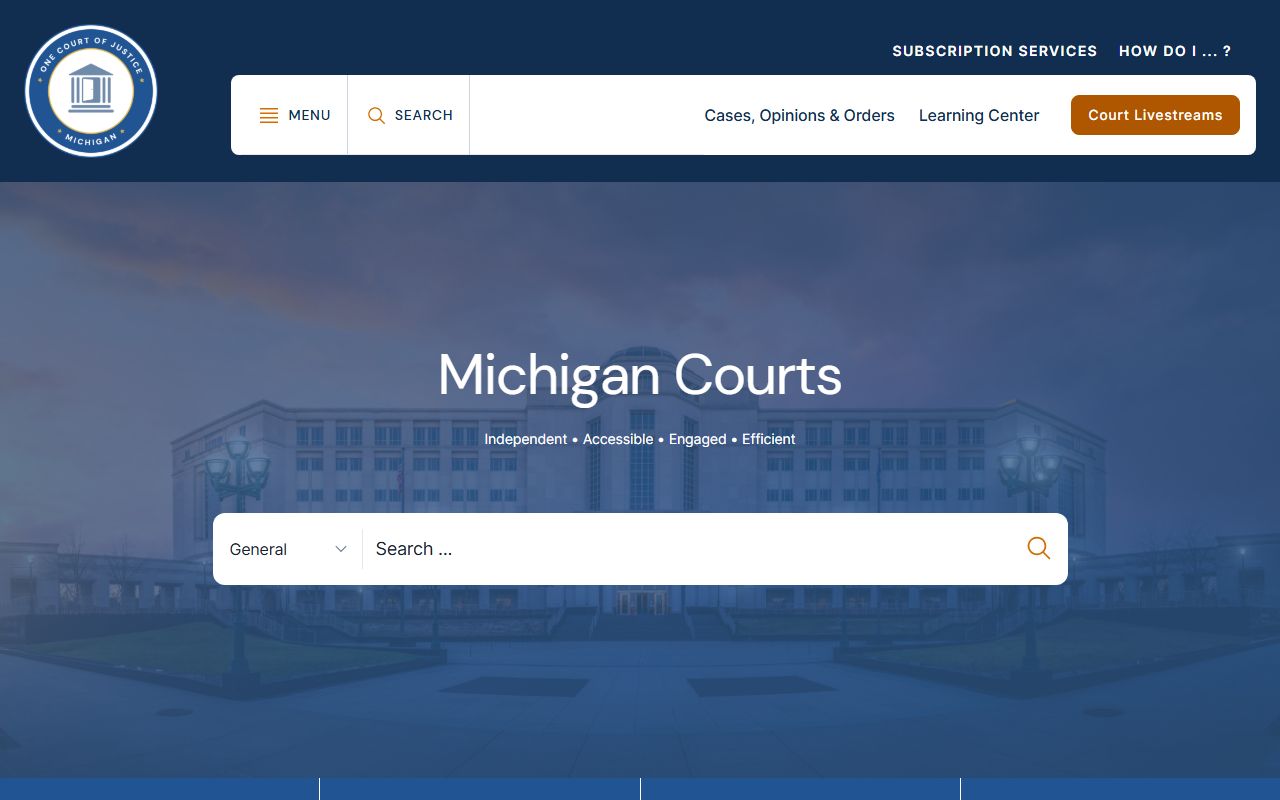
The Michigan Courts website at courts.michigan.gov is where you'll find the court directory and access to the public case search system.
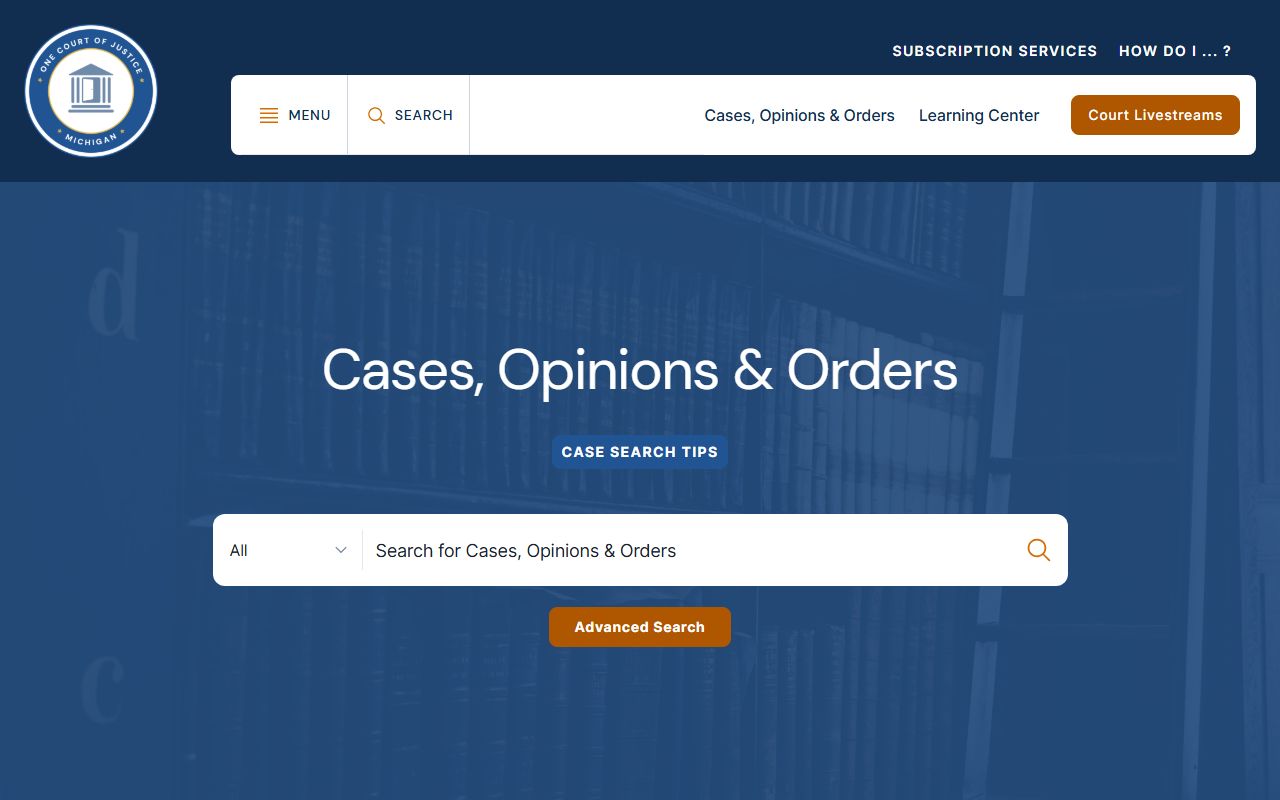
The case search portal at courts.michigan.gov/case-search/ lets you search cases across multiple Michigan jurisdictions without creating an account.
Michigan Inmate Population Statistics
Michigan's inmate population has one of the lowest recidivism rates in its recorded history. The current rate sits at 21%, which means 79% of people paroled in 2021 did not return to prison within three years. That's a significant improvement from earlier years and reflects changes in reentry programming, parole supervision, and other MDOC initiatives. The MDOC research and statistics page has the full data behind these numbers.
The demographics of Michigan's state prison population show a wide gap between the general population and those incarcerated. About 53% of inmates are Black, even though Black residents make up roughly 15% of Michigan's overall population. White inmates account for about 45%. Women represent approximately 6% of the state prison population. That female population grew from 621 in 1978 to 2,151 in 2017, a pattern seen in many states over that period.
One thing to know about the demographic data: MDOC does not use self-reporting for race categories. The Corrections Management Information System (CMIS) uses a simpler White or not-White classification. OTIS uses more detailed categories including Black, Hispanic, Asian, and others. The categories reflect staff observations, not the offender's self-identification, which makes direct comparisons between reports tricky.
Michigan runs 39 state prison facilities across the Lower and Upper Peninsulas. Facility security levels range from Level I (minimum) to Level VI (administrative segregation). The majority of the inmate population is housed at Level II and Level IV facilities. MDOC provides healthcare, mental health services, GED programs, vocational training, and substance abuse programming across its facilities.
Michigan State Prison System Overview
The Michigan Department of Corrections operates 39 state prison facilities through its Correctional Facilities Administration (CFA). The CFA oversees day-to-day operations, security, and inmate services across all facilities statewide. MDOC's authority comes from MCL 791.101, which established the department and set its responsibilities. You can reach MDOC at P.O. Box 30003, Lansing, MI 48909, or by email at correctionsinfo@michigan.gov.
Michigan prisons use a six-level security classification system. Level I is minimum security. Level II is low-medium. Level IV is medium security. Level V is maximum security. Level VI is administrative segregation, which is the highest restriction level and applies to inmates who pose a serious threat to safety or order. Most people in the Michigan inmate population are housed at Level II or Level IV. Placement is based on the offense, sentence length, disciplinary history, and other risk factors assessed at intake.
MDOC provides a range of services meant to support rehabilitation and successful reentry. These include GED and vocational training programs, substance abuse treatment, anger management, and mental health care. Visiting is allowed at most facilities, including virtual visit options. Information about visit schedules and procedures is available at michigan.gov/corrections/services/visiting-information.
Notable Michigan Correctional Facilities
One of Michigan's oldest and most well-known facilities is Parnall Correctional Facility, located at 1780 East Parnall Road in Jackson, Michigan. It opened in 1926 and houses 1,696 adult male inmates at a Secure Level I (minimum security) classification. Warden Noah Nagy oversees operations there. The facility can be reached at 517-780-6004. More information is available on the Parnall Correctional Facility page on the MDOC website.
Jackson County has a long history as a hub of Michigan's correctional system. The facility page shown below gives an example of what the MDOC provides for each prison in its online directory.
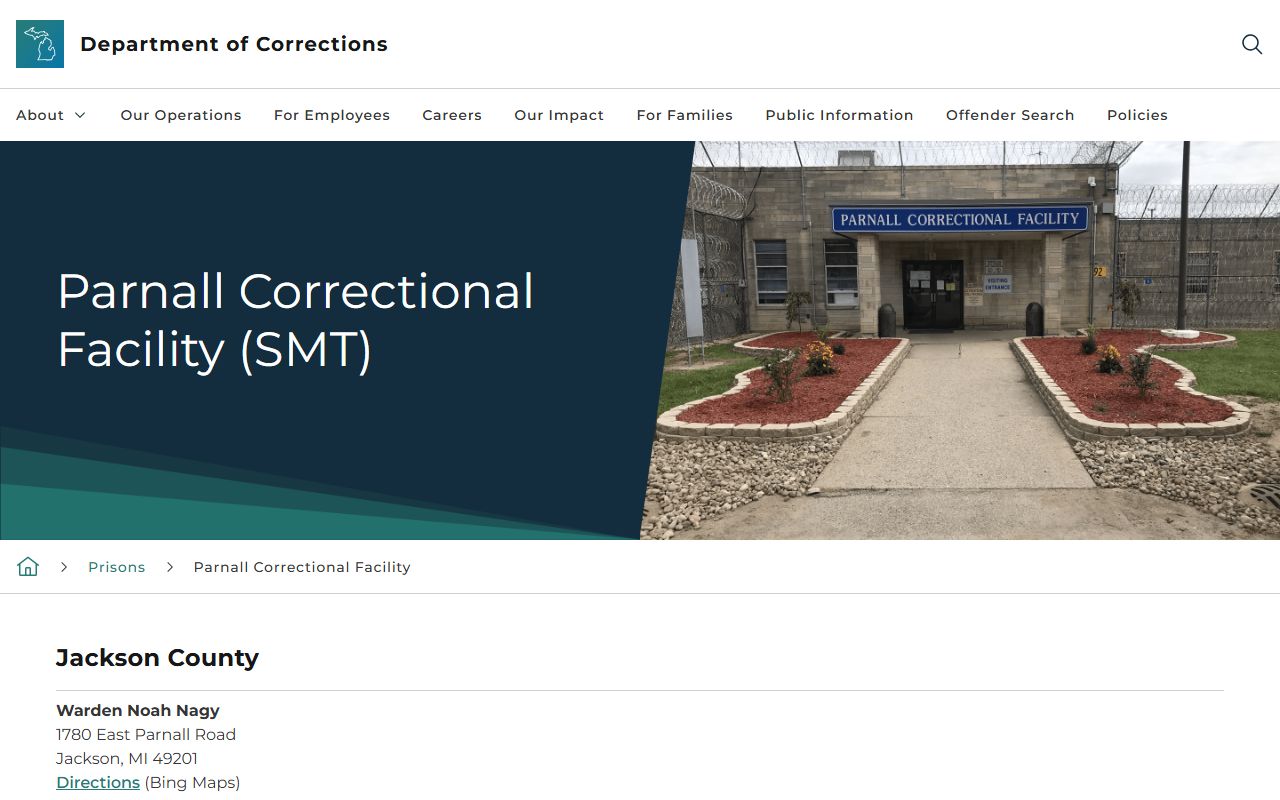
Each facility in the MDOC directory at michigan.gov/corrections/Prisons has a dedicated page with address, phone number, security level, and warden information.
When you need to contact a specific prison to confirm an inmate's location or ask about visiting, the MDOC facility directory is the right place to start. Facility pages include direct phone numbers and are kept up to date as staff and capacity changes occur.
Note: Inmate facility assignments can change due to transfers. Always confirm current location through OTIS or by calling MDOC before visiting.
Legal Framework for Michigan Inmate Records
Michigan law shapes what inmate population records are public and how you can access them. The core access law is MCL 15.231, Michigan's Freedom of Information Act. It creates a presumption that public records are open unless a specific exemption applies. MDOC records are subject to FOIA, but certain categories like medical records, active investigations, and victim information are protected under MCL 15.243.
MCL 791.233 governs parole eligibility and explains when parolees appear in the OTIS database. Parolees remain under MDOC jurisdiction and show up in the system until their supervision ends. Once discharged, the three-year rule under MCL 791.235 determines when their record is removed from OTIS. MCL 791.211 regulates which parts of a prisoner's record are confidential, particularly security-related information that could compromise facility operations.
County jail authority comes from MCL 801.1, which gives counties the right to establish and maintain jails. MCL 800.31 sets minimum standards and inspection requirements for those facilities. These statutes explain why county jail records are held separately from MDOC records and why OTIS won't show county-held inmates. For probationers in the OTIS system, MCL 762.11 covers delayed sentencing and probation supervision requirements.
Michigan courts provide additional context for inmate records. The Michigan Courts system maintains case records that are separate from MDOC custody records. Both are public but serve different purposes. Court records show what charges were filed and what the outcome was. MDOC records show where someone is and when they might be released. Used together, they give a full picture of someone's involvement with Michigan's criminal justice system.
Browse Michigan Inmate Population by Location
Michigan inmate population records vary by county and city. Each county jail operates independently, and state prison inmates are distributed across 39 facilities statewide. Browse by location to find resources for a specific area.
Michigan County Inmate Population Records
Select a county below to find local jail information, county sheriff contact details, and inmate population search tools specific to that area.
Michigan City Inmate Population Records
Major Michigan cities have their own local jails and police holding facilities. Select a city to find local inmate population search resources for that area.